Balcony solar in the UK
(Want to know more about plug-in solar? Here’s a French website (in English) that provides more details).
In the long list of new technologies that might help reduce carbon emissions ‘plug-in solar’ sits towards the bottom. A small array of PV panels perched on the garage roof, or perhaps fixed to the railings of a balcony or laid on supports in the garden, and then directly connected into an ordinary plug in the wall, is never going to make a major difference to the course of climate change.
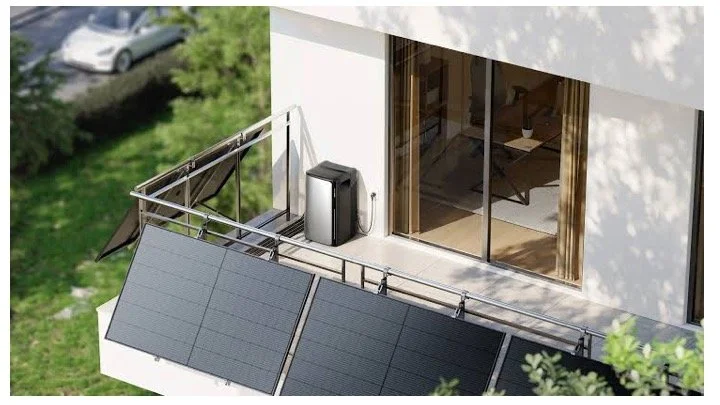
Source: Svea Solar, the supplier of balcony solar to IKEA in Germany
Nevertheless, the UK should encourage this form of power generation, joining all the major European countries bar Sweden in removing regulatory restrictions that block householders from connecting PV directly into the household electricity supply.
Today, all solar panels that have been installed on the roofs of UK houses are connected into the distribution panel with a separate fuse. The major difference introduced by plug-in solar is that the electricity is delivered directly into the home power network via an existing socket. This makes it possible for the homeowner or tenant to install a simple PV array without the use of an electrician and at very much lower cost than fixing panels on the roof of a house. When necessary, the panels can be moved to a different flat or switched to a different position in the home.
Plug-in solar dramatically widens the potential for installing solar panels, making cheaper electricity available to far more UK homes than the 1.6 million which benefit from the technology now. A well-designed system, along with an app for a mobile phone, can be put in place in under half an hour. Relatively few householders have balconies in the UK because more people live in single family houses than in Germany. But many homes have gardens, sheds or garage roofs on which the panels can be placed.
The UK government commissioned research into the safety of plug-in solar in mid 2025. This work appears to have been completed this month. We should now push for rapid deregulation of this way of reducing emissions and household electricity bills.
The German experience.
Plug-in solar is best developed in Germany as a result of deregulation in 2019. At the end of last year, just over 1.2 million households had registered PV panels that are fed directly into the house’s electricity circuit. This figure had risen by over 430,000 in 2025 alone.[1]
The German regulator estimates that plug-in solar, or ‘balcony solar’ as it is usually called there, provides about 1.2 GW of capacity or just one per cent of total national PV installations.
However these plug-in solar figures are frequently said to be far too low by experts in the field. Many householders haven’t bothered to fill in the forms at the German regulator and so aren’t recorded in these estimates. I’ve seen figures for plug-in penetration as high as 4m homes, or over three times as much as officially recorded.
Even using the more substantial informal estimates, plug-in solar probably accounts for less than 2% of total German electricity production. (We can be confident that the typical productivity of a kilowatt of plug-in solar will be less than the equivalent amount of capacity in an open field and facing due south).
Despite the name, one estimate, albeit dating from 2022, was about only about 29% of ‘balcony solar’ units are actually placed on balconies. It is more usual to have the panels in the garden or on a garage roof, tilted towards the sun.
The typical size of a plug-in solar unit is about 1 kW, composed of two of three panels, an inverter that turns the DC output into AC and cabling that takes the output to a conventional socket in the wall. The panels are usually far lighter than conventional roof panels and can be easily fixed to walls or to outbuildings.
Depending on the region in which the panels are installed, a balcony solar unit of 1 kW might generate around 700-1000 kWh a year. This will vary according to whether the panels are facing south, the losses from shading and whether the unit is positioned vertically or at a more appropriate 35 degrees to the horizontal. (For comparison, the average household consumption in the UK is around 3,000 kWh).
Not all the electricity produced will be used in the house or flat. On a sunny day in June a 1 kW installation will be generating far more than the property needs and the surplus will flow out into the local grid even if the householder is careful and runs major appliances only when the sun is shining. Most published estimates (and some seem to be little more than guesses because the number is difficult to measure accurately) suggest a typical saving of 10-15% of electricity bills in countries such as Germany.
The possible impact in the UK
In the UK, with its very high domestic electricity prices, a cut of 15% in bills might be worth £100 or more. Is this worthwhile? In terms of payback time, the answer is ‘yes’. 800 Watt units on sale in Germany and elsewhere are priced at around €400, or about £350. (We recently bought a much smaller 440 Watt unit for a house in France for €299, or around £260).
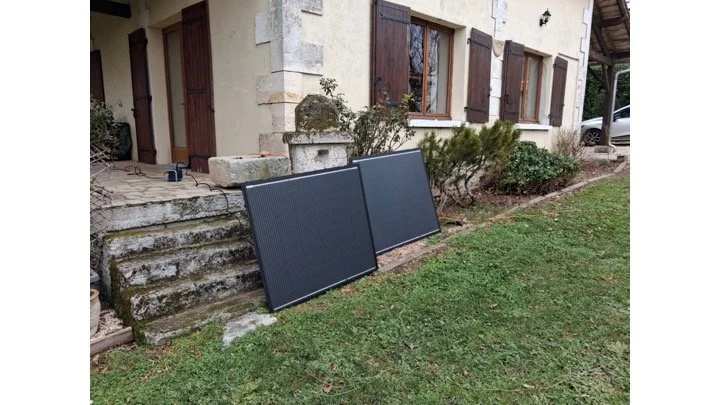
Lightweight slim solar panels, plugged into a house socket and waiting to be attached to the wall of our house.
These prices imply a payback period of around 4 years and some protection against the likely future rises in electricity prices.
Perhaps more importantly, the anecdotal evidence from around Europe seems to be that ‘balcony solar’ is effective at improving support for renewables more generally. Owners become happier to support the energy transition..
Perhaps of particular note was a comment from our French supplier that it believed that the purchasers of its units were often aged over 60. This group is usually less well informed about climate change and less eager to back a renewables-based economy. So plug-in solar may be helpful in building wider support for increasing the speed of the transition. Also many of these older people are retired and have the time to schedule their electricity using activities such as turning the washing machine on at times when the sun is out. In my personal experience, this is exactly the sort of activity that provides enjoyment to the older types who have bought these solar kits.
So why is the UK almost the last country in Europe to allow balcony solar?
A domestic solar system pushing electricity back into the local network needs to disconnect immediately if the grid goes down. Otherwise someone working on repairing the network might receive an electric shock from the home solar. Each type of inverter that is given permission to be sold to domestic consumers needs to show that it will automatically shut down with a tiny number of milliseconds if the grid itself has ceased to operate. Other countries have all done this work and 25 out of 27 EU states allow plug-in solar. It is time the UK comes into line and also authorises sale and installation. Any other choice is just delaying the government’s achievement of a carbon-free grid.
[1] German data on balcony solar can be found in these documents
https://www.bundesnetzagentur.de/SharedDocs/Pressemitteilungen/EN/2026/20260108_EEG.html