The new longer duration storage sites in Great Britain
Britain is going to get a lot more electricity storage as a result of recently announced plans for new batteries and pumped hydro. The press didn’t notice just how transformative this might be.
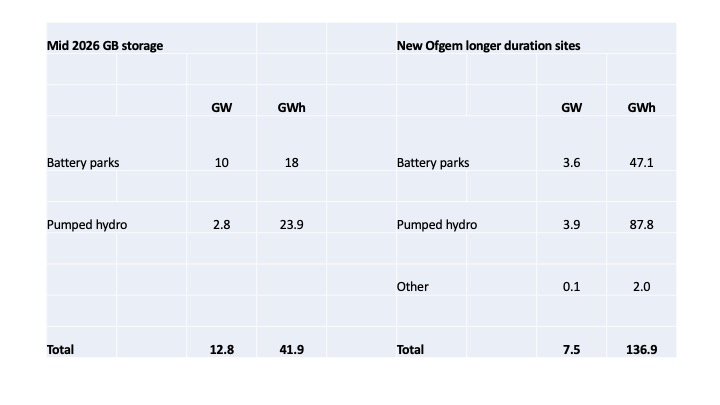
As of June 2026, Great Britain has about 10 gigawatts of grid battery capacity, capable of delivering about 18 gigawatt hours of power.[1] In addition, four pumped hydro sites offer storage around 24 GWh. That’s enough to meet total national demand for about an hour. (Of course this figure will rise over the next years as more batteries are added to the grid).
The 16 new longer duration storage sites identified last week as ready for approval by the regulator Ofgem have a power output totalling 7.6 GW, or much less than today’s short duration battery park. But because they are designed to operate for much longer, the total energy they will be able to deliver is over three times as much as all the existing grid storage sites, including today’s pumped hydro.
This note assesses what the new stores are intended to deliver, what the cost will be and how much difference they will make to the storage requirements of an electricity system increasingly dominated by variable renewables.
In the table below, GW refers to the maximum electricity flow that the sites can provide while GWh is the maximum electricity flow multiplied by the number of hours that this rate of charge/discharge can be sustained.
Source: Ofgem, various press reports
When the longer duration sites have been completed, probably early in the 2030s, they will contain enough to provide all the electricity GB that needs for about four hours.
The biggest new site will be the pumped hydro plant at Coire Glas in the north of Scotland, offering 1440 megawatts for 32 hours, implying a total capacity of over 46 GWh, or more than all today’s grid storage sites combined. The batteries on the list typically offer about 200-500 MW working for 8 to 18 hours.
The role of the new storage sites is intended to be different to today’s storage plants:
· Today: batteries and pumped hydro trade in the electricity market, delivering services for minutes and hours. Their role is provide short-term arbitrage, taking in energy when the price is low and selling it soon after for a higher price.
· In 2030: the new storage will work for hours and days, often focused on taking in excess power from wind farms when the electricity would otherwise be curtailed and then selling when power is in short supply perhaps a few days later.
The principal geographic focus of the new storage will be to deal with the electricity being delivered from offshore wind farms off the north of Scotland. About 80% of the storage capacity on Ofgem’s list will be sited in the northern half of that country, include 4 batteries and all 3 pumped hydro projects. The limited transmission capacity from Scotland into England means this is where curtailment is most likely to be avoided using storage. (But, rather than add storage, might it have been better to initially route the transmission cables from the wind farms directly into England, rather than northern Scotland?)
The cost of the 16 proposed projects is difficult to estimate. The Coire Glas pumped hydro site is said to have a budget of around £1.5bn, meaning a cost of around £33 per kWh of capacity. The other very large pumped hydro plant, Earba, seems to be much more expensive, at perhaps £60 for each kWh, but precise numbers are not easily available. An average of around £45 for the three pumped hydro plants on the list seems appropriate.
The analysts at Ember assessed new batteries in last months of 2025, concluding that the cost was approximately $125 per kWh, or around £95.[2] This estimate was for short duration batteries, which will have a slightly higher cost per kWh than the batteries delivering power over longer periods. (It is also worth mentioning that longer duration batteries also have slightly better round-trip efficiency because they need less electricity for cooling). So the figure for longer duration batteries in late 2025 might have been £90 per kWh. It will have declined further since the Ember work and we can estimate a figure of perhaps £75 in mid 2026.
If these rough estimates are correct, the cost of the 16 proposed projects will be around £7.5 billion. To put this in context, one estimate of the total cost of all curtailment in the GB electricity system in 2025 was just under £1.5bn, or about one sixth of this amount.[3]
By what percentage might the new projects reduce total GB curtailment? An accurate answer would require detailed modelling but I have made some rough estimates of the likely impact. The total amount of curtailed electricity in 2025 was just under 10 terawatt hours (TWh), or about 72 times the 136.9 GWh capacity of the new sites, if they are all built. That’s approximately one charge and discharge every five days to capture all the otherwise curtailed electricity.
Is this remotely likely? The issue faced by the operators of these new longer-duration storage sites is that the country tends to swing from periods of high wind to little wind, each lasting several days. But each discharge and charge process will take, across all the 16 storage locations, about 36 hours or a day and a half.[4] In other words, there are many times a year when the batteries and pumped hydro dams will fill up at the beginning of a windy week, and then not be able to discharge because the electricity transmission system is still overcrowded. When the wind has subsided, the batteries will be emptied but the low wind speeds will then mean that there is no very cheap electricity to fill them up again until the gales start and curtailment resumes perhaps a week or so later.
Looking at the wind generation patterns for the first half of 2026, my guess - and it is nothing more than a guess - is that so far it would have been possible to fill and empty the storage sites between 12 and 18 times, implying a possible annual rate of around 30. Of course performance will change as offshore wind develops and UK electricity demand begins the slow climb upwards that we expect. But if these longer duration batteries and new pumped hydro were installed today, I’d expect them to avoid perhaps 40% of all curtailment in the GB system.
As importantly, periods of low wind speeds, such as occurred in late April 2026, would have used up all the 136.9 GWh of electricity in the new stores. These longer-duration sources wouldn’t have been enough to allow us to completely turn off gas turbines. That will require a third type of electricity storage that keeps energy for ‘weeks to months’. As always, I suggest that this storage will be best provided by hydrogen.
[1] These numbers are best estimates. The numbers are changing rapidly.
[2] https://ember-energy.org/latest-insights/how-cheap-is-battery-storage/
[3] https://renewables-map.robinhawkes.com/curtailment
[4] 36 hours is the total capacity of the new storage sites (136.9 GWh) divided by the total input/output rate (7,645 MW) times 2 to reflect the need to take in and then push out the electricity. I have wrongly assumed 100% round trip efficiency when the correct number might be 90% for longer duration batteries.