The hidden failure of the world's most important carbon capture site
Several European news outlets carried an article last week by a Belgian journalist about the poor performance of the world’s most important carbon capture site at Brevik in Norway, where Heidelberg Materials operates a large cement works.[1] Having promised to deliver 360,000 tonnes into permanent storage in its first year - and 400,000 tonnes thereafter - the Brevik works seems to have achieved less than a third of this amount.
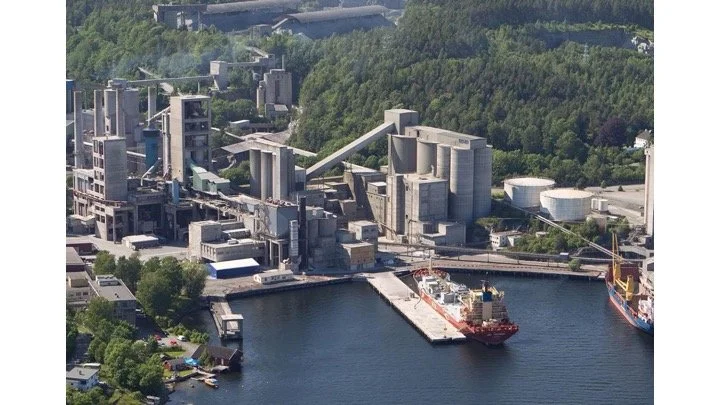
The Brevik cements works in southern Norway
Heidelberg does not appear to dispute the newspaper analysis but has yet to admit the failure, presumably because it is in negotiation with several other governments over support for other CCS projects. The company’s various web sites all still continue to claim that Brevik is successfully capturing 400,000 tonnes a year and make no mention of the reasons why performance has fallen significantly short.
As far as I see, no British news site covered the European news story, even though the current government agreed last year to financially support Heidelberg’s much larger CCS project at a cement factory in North Wales. No details of the state support have been provided but the UK subsidy may very well exceed £500m. As usual, the government excuses its failure to give financial information as being justified by the ‘commercial sensitivity’ of the grant.
The failure at Brevik to achieve the target level of CO2 capture raises doubts over whether the similar site in North Wales will also struggle. There, the target is 95% capture of all emissions, a level not achieved at any other CCS project in the world.
The Brevik case appears to be yet another example of a CO2 capture project that fails to deliver on its initial promises. Costs are much higher than expected while the storage of emissions is far below the amount. We need to discuss why this pattern is occurring rather than allowing the recipients of huge state subsidies to avoid any questioning of their performance.
Heidelberg Materials and Brevik
Cement manufacture accounts for about 7% of global CO2 emissions. The CO2 comes from two sources. The manufacturing process uses large amounts of heat, almost invariably provided by burning fossil fuels, in order to break down calcium carbonate (CaCO3) into lime (CaO) and CO2. Both the emissions from the use of fossil fuels and the chemical breakdown are invariably vented to the air.
Heidelberg Materials (HM) is one of the largest cement companies, operating in many countries around the world. While other cement manufacturers have focused on other routes to the decarbonisation of their processes, HM has aggressively backed carbon capture.
Its plant at Brevik in southern Norway generates about 800,000 tonnes of CO2 a year, about 2% of the country’s total emissions. Brevik’s CO2 capture installation, attached to the cement works, was built over the last five years to collect the gas, compress it and then ship to a port on the west coast of Norway where it would be further compressed before being transmitted by pipeline to permanent storage under the North Sea. The CO2 capture process requires substantial amounts of heat, more than the plant itself can provide, and so the published target has always been to permanently store half of its total emissions, or 400,000 tonnes.
The Brevik site is the first in the world to capture large quantities of CO2 from the cement manufacturing process and is widely seen as the single most important CCS experiment in the world.
It seems to have cost about €400m, of which the Norwegian government paid about 80%. To give this number some context, if Brevik operated successfully for 20 years and stores 400,000 tonnes a year, the repayment of capital alone, before taking into account interest payments and the high operating costs, would cost €50 per tonne of CO2. Precise details of the other costs are not available but might well triple this figure, meaning that even if Brevik eventually succeeds in storing 400,000 tonnes of CO2 a year, the price will be perhaps €150 a tonne, twice the level of the current value in the EU carbon emissions trading scheme. It may be worth noting that the Norwegian government also pays 80% of the operating costs of the Brevik capture plant.
The apparent underperformance
After final approval in 2020, the Brevik CCS project was completed in May 2025 and formally opened in June. The press release covering the opening event, attended by Norwegian royalty, said that HM had already begun to ship pressurised CO2 to the port which acts as the point of final storage. The project is therefore just over a year old and should now have delivered 360,000 tonnes into permanent storage.
The journalist investigating the underperformance at Brevik had access to documents which, for example, record how much gas has been shipped to the underground storage site, the claims made by HM for carbon allowances as a result of CO2 capture and even the number of voyages taken by the small tanker which transports liquid CO2 to the port where it is finally stored and then taken offshore by pipeline.
I have looked at one of these sources and the data seems to support the reporter’s conclusions.[2] Only about 105,000 tonnes have been injected into the North Sea storage site between the point at which shipments started in August 2025 and the end of May 2025. (The CO2 captured from May 2025 to July 2025 was stored temporarily at Brevik itself). Only in two months were the volumes placed in sub-sea storage roughly equal to the amounts required to meet HM’s promises for carbon capture.
The investigative news article writes about checking the 105,000 tonnes figure with the company:
‘When asked, Heidelberg Materials confirmed these figures but claims to have ‘recently’ succeeded in achieving the promised performance. The German cement company told us that the project was still ‘in the ramp-up phase, which is normal for an innovative project of this scale’.
The article goes on to comment that ‘Heidelberg Materials had however declared at the beginning of the year (I assume 2026) that this period of ramp-up was attained in summer 2025.’
I wrote to HM to ask whether these assertions were correct but have received no response as yet. And the various HM websites all continue to assert today that Brevik takes in 400,000 tonnes a year. For example, one page says
Annual volume of CO2 captured: Approximately 400,000 tonnes per year.[3]
What is causing the lower rate of CO2 storage?
The causes of the slower than forecast capture rate are unclear. However a fascinating and surprisingly honest article summarised some of the problems experienced when the project was being constructed. This may provide some guidance as to why the Brevik CCS site has experienced delays and apparent under-performance.
The general conclusion of this paper, authored by people working for HM on the project, is that the plant hired a large number of offshore oil and gas engineers into a construction team that actually needed the simpler skills associated with onshore chemical plant construction.[4]
Two paragraphs are particularly brutal:
The staffing of CCS projects is challenging as few people have the necessary experience. However, a ready source of talent can be obtained from the oil & gas sector. In the Brevik CCS project a portion of the owner’s project team and all of the main contractor ́s personnel came from the oil & gas industry in Norway. This difference in experience created significant misunderstandings, miscommunication, and frustrations. Simple issues became complex, complicated situations were underestimated. Both industries use similar terms but they convey different meanings. In addition, the oil & gas industry often has more expensive technical specifications due to the more dangerous chemicals they work with.
The project was not able to find an effective method to properly address this challenge, despite many attempts. The lesson learned is to create new terms and definitions for activities where similar words are used in both industries. For example snow to Calgarians has a different meaning to Indonesians. Commissioning in the oil and gas industry is that different to commissioning in the cement industry.
Moreover, despite the huge scale of the construction work, the owners were reluctance to set an appropriate budget and did not view the task as the first of the many commercial developments of CCS on its cement plants. The following sentence (written by HM employees!) is particularly telling:
The Brevik CCS project started over 6 years ago with the understanding that it was a proof of concept and that costs should be kept to a minimum.
Will the same logic impede the construction of a reliable CCS system in North Wales?
Implications for the UK’s carbon capture endeavours
So far, the Brevik CCS plant does not appear to have delivered on the promises made by HM to Norway and the EU. Vast amounts of public money, mainly from the government of Norway, have been directed towards a project that seems only a very partial success. Yet the UK has promised to support a scheme on a much larger scale even though HM has so far not publicly confirmed the reasons for the apparent failure of the Brevik CCS site.
The UK government has committed £22bn to supporting CCS sites around the UK. It may well be correct that CCS is a vital part of the Net Zero project but to commit this cash without a clear understanding of why Brevik is currently failing, and how the UK can avoid these failures, seems fiscally irresponsible. And HM needs to be far more open about the problems in Norway and should cease to assert that it is storing half the Brevik’s plant CO2 output.
[1] One of the news stories is here: https://www.mediapart.fr/journal/ecologie/100626/climat-le-fiasco-du-megaprojet-de-stockage-du-co2-de-totalenergies
[2] https://factpages.sodir.no/en/storage/TableView/Injection
[3] https://www.brevikccs.com/en/facts-and-faq
Read on June 15th 2026
[4] Lessons learned in the design and construction of the Brevik CCS facility: Andrew Burns, Ytalo Davila Gomez, 17th International Conference on Greenhouse Gas Control Technologies, 2024.